
Choosing A levels is one of the most consequential academic decisions a student makes before university. Unlike GCSEs, where you study 8 to 10 subjects, at A levels you choose just three subjects to study in real depth over two years. That narrowing is exactly what makes the choice feel so significant.
The good news: there is no universally correct combination. The harder reality: there are wrong combinations for specific goals, and mistakes that are much harder to undo once you are already in Year 12.
What Are A levels?
A levels are the main pre-university qualification in England, taken in Years 12 and 13 (Sixth Form) at ages 16–18. Most UK universities base their offers almost entirely on A level grades: predicted first, then confirmed when results arrive in August.
They are graded A* to E. Most degree courses at competitive universities ask for between A*A*A and BBB, depending on the course and institution. Some pupils do more than 3 subjects.
One point worth stating clearly: three outstanding grades consistently impress universities more than four or five average ones. Taking four A levels rarely gives a meaningful advantage unless you are targeting Oxbridge or very specific competitive courses. Quality always wins.
How Many A levels Should Students Take?
Most students take three A levels. Some take four, particularly those applying to Oxford, Cambridge, or highly competitive science and medicine courses. Five A levels is rare and generally not recommended.
Some schools still offer an AS-Level in a fourth subject, taken only in Year 12. This can be a useful way to try a subject before committing, but AS-Levels no longer contribute to A level grades and are considered separately by universities.
Full List of A level Subjects
Available across AQA, Edexcel, OCR, and Cambridge. Availability varies by school.
Sciences and Mathematics
Biology
Chemistry
Physics
Mathematics
Further Mathematics
Computer Science
Environmental Science
Statistics
Humanities
History
Geography
Philosophy
Classical Civilisation
Ancient History
Archaeology
Social Sciences
Economics
Psychology
Sociology
Politics and Government
Law
Anthropology
Modern Languages
French, Spanish, German, Italian, Russian
Mandarin Chinese, Arabic, Japanese, Portuguese
Classical Languages
Latin
Ancient Greek
English
English Literature
English Language
English Language and Literature (combined)
Creative and Performing Arts
Art and Design: Fine Art, Photography, Graphic Design, Textiles
Drama and Theatre
Dance
Music
Music Technology
Film Studies
Media Studies
Business and Applied
Business
Accounting
Physical Education
Religious Studies and Philosophy
Global Perspectives (Cambridge)
Note: General Studies and Critical Thinking are offered by some schools but are not accepted as one of three A levels by most competitive universities. They can be taken as extras but should never replace a core subject in your combination.
Facilitating Subjects
The Russell Group uses the term 'facilitating subjects' to describe A levels that keep the widest range of degree options open. If a student is not sure what they want to study, building a combination from this list is the safest approach.
Mathematics
Further Mathematics
English Literature
Physics
Biology
Chemistry
History
Geography
Modern Languages
Classical Languages
Important: these are not universally better subjects; they are better for keeping options open. A student who knows they want to study Art or Drama has no reason to force three sciences into their combination. The principle matters most for students who are uncertain about their direction.
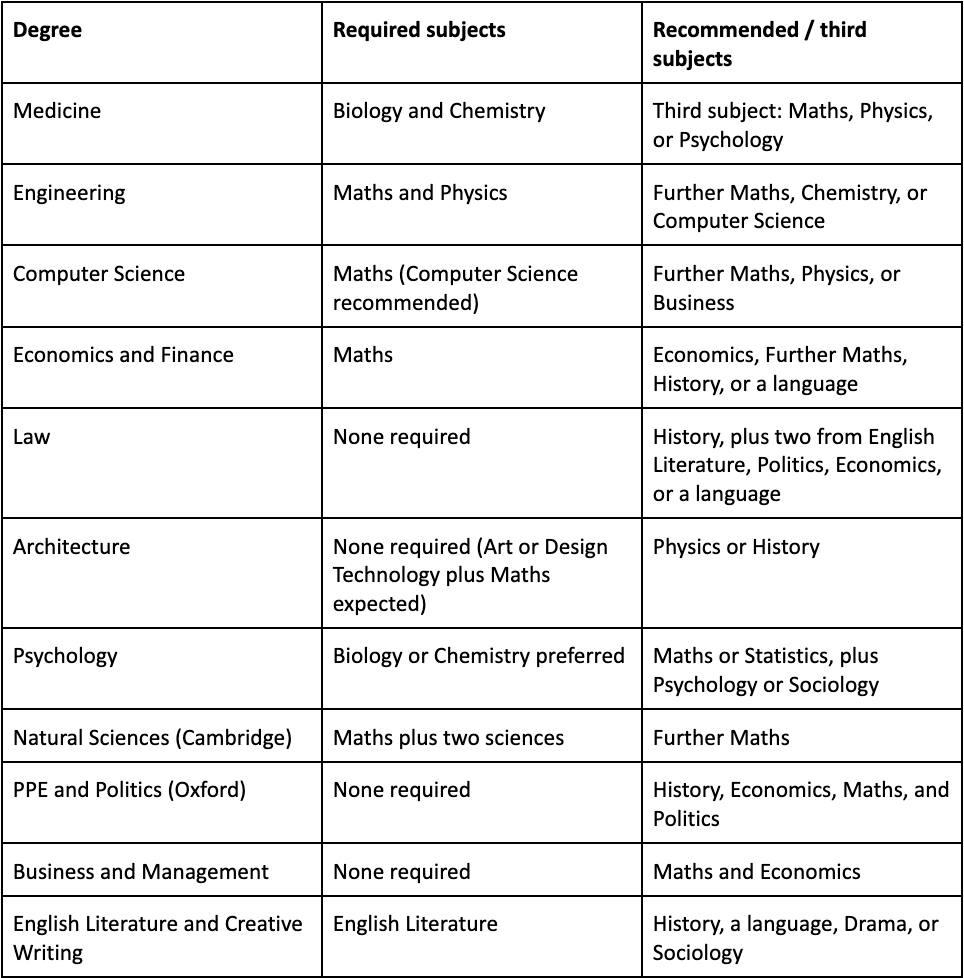
A level Requirements and Recommended Combinations by Degree
Always check the entry requirements for two or three target universities in your intended subject before finalising choices. The following reflects common expectations. Individual institutions vary.
How to Choose: 6 Questions Worth Asking
1.What does the degree I want actually require?
Start here before anything else. Look up entry requirements for two or three target universities in your intended subject. Are there compulsory subjects? Are certain subjects strongly recommended? If you have a target course, this question should anchor your entire combination.
2. Am I genuinely strong in this or just interested?
Interest carries you through the first term. Real ability carries you through two years of exams. Ideally you want both. But a subject you find fascinating yet consistently struggle with is a more dangerous choice than one you are strong in and find reasonably engaging. Look at GCSE grades honestly.
3. What is the assessment style and does it suit me?
Mostly final exams: Maths, Sciences, History, Languages. Significant coursework: English Literature, Geography (fieldwork investigation), Art (portfolio up to 60% of marks), Business. If your child produces their best work on projects rather than under exam conditions, weighting toward coursework-heavy subjects is a legitimate strategic choice.
4.Does my combination hold together?
Maths, Physics, and Chemistry together is a heavy workload with significant content overlap: right for committed scientists, punishing for anyone ambivalent. Three essay-heavy humanities subjects can appear narrow to universities looking for evidence of quantitative ability. Creative plus Science plus Humanities combinations are genuinely valid for interdisciplinary paths like architecture or science communication. Also: always check for timetable clashes before committing.
5.What are 'soft' A level subjects, and should I care?
Certain A levels (General Studies, Critical Thinking, Media Studies, Film Studies, Travel and Tourism) are viewed less favourably by some competitive universities. One alongside two strong academic subjects is rarely a problem. A combination of three such subjects for a student targeting Russell Group universities is a genuine risk.
6.Is this genuinely my choice?
Family expectations, peer choices, and teacher recommendations all shape A level decisions, sometimes more than students realise. Two years is a long time to carry subjects chosen for the wrong reasons. The best-performing students consistently feel genuine ownership over what they are studying.
Specific Advice for International Students
Subject Knowledge Gaps
Some A level subjects assume GCSE-level UK content as a foundation. A level Chemistry builds directly on specific material covered at GCSE. A student joining from abroad without equivalent preparation may need focused bridging work before or early in Year 12.
English Language Expectations
Fluent conversational English is not the same as the analytical essay writing required in English Literature, History, or Law at A level. This is a common and genuine gap that needs deliberate preparation; it does not resolve itself.
UCAS and the Application Timeline
Applications are submitted in October or November of Year 13, with universities making offers based on predicted grades, and results arriving in August. International students who have not navigated this before benefit significantly from early guidance on how the system works.
The EPQ
Many Sixth Forms offer an Extended Project Qualification alongside A levels, an independent research project worth up to half an A level in UCAS points. Oxford and Cambridge look favourably on strong EPQs. If your school offers it, it is almost always worth doing.
The IB as an Alternative
The International Baccalaureate is offered by some UK independent schools as an alternative to A levels. It is widely accepted by UK universities and well regarded for students who want a broader academic profile. Most state Sixth Forms offer A levels only.
EducAd note: We regularly support international students transitioning into UK Sixth Forms, including identifying knowledge gaps, creating bridging study plans, and advising on A level combinations that work with specific university targets. Early preparation makes a measurable difference to Year 12 performance.
Before You Finalise: A Practical Checklist
Check UCAS entry requirements for your top three target courses, before choosing, not after.
Verify your school offers all the subjects you want, and that there are no timetable clashes.
Read the actual specification for each subject, not just the name. Know what you are committing to study for two years.
Understand how each subject is assessed. Know the split between exams and coursework.
Be honest about GCSE grades in subjects you are considering continuing. A grade 6 is a meaningful indicator of how A level will feel.
Attend subject taster sessions if your school offers them before choices are finalised.
Talk to current Year 13 students about what they wish they had done differently.
Get independent advice if you have specific university targets. A generalist school advisor does not always know the requirements for competitive niche degrees.
Need help choosing A levels that match your university goals? EducAd Consulting works with international students and families to build the right combination from the start. Book a free consultation at educadconsulting.com
Watch our video: https://www.youtube.com/watch?v=XUAmyj03BqI&t=2s