
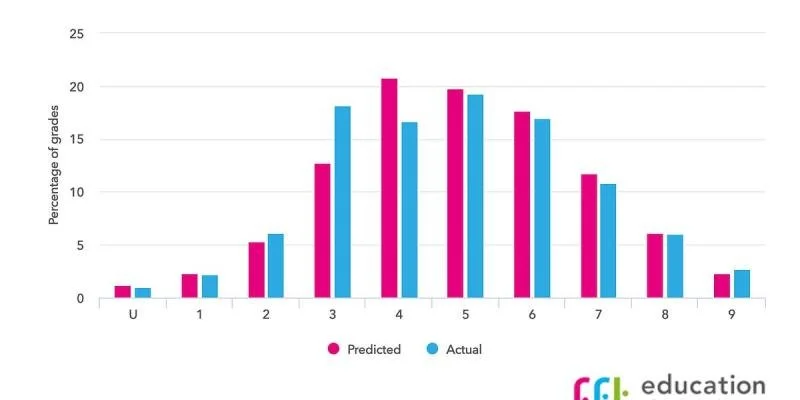
Applying to a UK university or private school often seems like trying to predict the weather. You have a forecast (your predicted grades), but you also know that British weather is famous for doing exactly what it wants, regardless of what the weatherman says.
This is where the battle between predicted grades and historical entry data comes into play. It is one of the most confusing parts of the application process for students and parents alike. You have the grades your teachers think you will get, and then you have the cold, hard data of what students actually got in previous years.
Navigating this gap is crucial. It is the difference between a wasted application slot and a strategic choice that leads to an offer. Let’s strip away the jargon and look at what these numbers mean, how to use AI to boost your chances, and how to ensure your application is as strong as possible.
What Are Predicted Grades, Really?
Let’s start with the basics. Predicted grades are exactly what they sound like: a prediction. They are an estimate of the grades your teachers believe you will achieve in your final exams (like A-Levels or IB).
However, teachers do not just pluck these numbers out of thin air. They look at your performance in mock exams, your coursework, your attitude in class, and how you have improved over the year. They want you to succeed, so they often try to be optimistic while staying realistic.
Think of predicted grades as your "ticket to the game." They are what you put on your UCAS application form. Universities use them to decide whether to make you a conditional offer. If your predicted grades meet or exceed the university’s published entry requirements, you are in the running.
Why do they matter?
In the UK system, most students apply to university before they have finished their final year. This means universities cannot make decisions based on what you have achieved, because you haven't achieved it yet. Instead, they rely on these predictions to decide whether to give you a "Conditional Offer."
If a university course requires grades of AAB, and your teachers predict you will get AAA, the university is likely to look at your application favourably. If you are predicted BBC, they will reject the application.
The pressure of potential
The tricky thing about predicted grades is that they are hypothetical. They are a promise of potential, not a guarantee of performance. This can create a strange situation where you are holding an offer for a dream university, but you still have to put in the hard work to make those grades a reality. If you miss the mark on exam day, that Conditional Offer can disappear.
Understanding Historical Entry
On the other side of the coin, we have historical entry. This can refer to two things, and understanding both gives you a massive strategic advantage.
First, "historical entry" often refers to applying to university after you have received your final grades. This usually happens if you take a gap year. In this scenario, you are not dealing with predictions. You are applying with concrete proof of your academic ability. This is often called a "post-qualification application."
Second, historical entry refers to the data on what grades a university historically accepts, which is sometimes different from what they advertise.
The "Unconditional" Route
If you apply with your actual grades (historical entry), universities don't need to guess. If you meet their requirements, they can give you an "Unconditional Offer." This means the place is yours, no matter what happens next. For many students, this removes a huge amount of anxiety. You know exactly where you stand.
The Reality Check
The other aspect of historical entry is looking at the reality of admissions. A university might state on their website that they require A*AA. However, historical data might show that they often accept students with AAA during Clearing or if the course isn't full. Knowing the history of a course's entry standards helps you spot opportunities that others might miss.

The Great Debate: Which Route is Better?
So, should you rely on your predicted grades and apply now, or wait until you have your results in hand? There is no single right answer, but here is how to weigh up the options.
The case for Predicted Grades
Most students in the UK follow this route. The main benefit is momentum. You finish school, you go straight to university, and you move forward with your peers.
It is also a great option if your teachers are optimistic. Sometimes, teachers will predict slightly higher grades to give a hard-working student a chance at a top-tier university. This gives you a shot at institutions that might otherwise feel out of reach, provided you can step up and do the work to meet the offer.
The case for Historical Entry
Applying with achieved grades is fantastic for risk management. If your mock exams went badly but you know you can pull it out of the bag for the finals, waiting might be smart. It stops you from receiving rejections based on low predictions that don't reflect your true ability.
It is also the best route for students who want certainty. If you have the grades in your pocket, the power dynamic shifts. You aren't asking the university to take a gamble on you; you are showing them you are already qualified.
Where Does EducAd Fit In?
Navigating this maze is stressful, but you don't have to do it alone. At EducAd, we act as your personal guide through the admissions wilderness. We help families make sense of these two pathways and build a strategy that suits their specific needs.
We help you manage expectations
If you are applying with predicted grades, we can help you select a balanced list of universities. We look at your "aspirational" choices (the dream schools), your "solid" choices (where your predictions match the requirements), and your "safety" choices. This ensures that no matter what happens on results day, you have a plan.
We advocate for you
Sometimes, predicted grades don't match a student's potential. If you feel your predictions are too low, our mentors can work with you to boost your academic performance and help you present a compelling case to your school to have them reconsidered before the application deadline.
We look at the data
Remember the second definition of historical entry? We have the experience to know which universities are flexible. We know which "strict" requirements might have wiggle room and which ones are set in stone. We use this knowledge to help you apply where you have the highest statistical chance of success.
Making the Choice That is Right for You
Whether you are racing towards a deadline with predicted grades or taking a measured approach with historical results, the goal remains the same: getting into an institution where you will thrive.
The university application process is not just a form-filling exercise; it is the first step in your adult life. It pays to be strategic. Don't just look at the shiny prospectus pictures; look at the numbers, look at your own learning style, and look at the timeline that makes you feel most comfortable.
If you are feeling overwhelmed by the choice, or if you just want a second pair of eyes on your application strategy, reach out to us. We love turning complex admissions puzzles into clear, actionable plans. Let’s get you ready for your future, one grade at a time.